Teddy Riner is 6 ft 8 in tall, fights at somewhere between 290 and 350 pounds, and has won five Olympic gold medals in a sport most Americans have never watched a full match of. If his name means nothing to you, that is the normal American experience of judo. It is also the reason he is worth explaining properly, because his career is one of the clearest demonstrations of what happens when a very large body meets a sport with no upper weight limit.
What follows is as much about judo as about the man. We have checked every number against current sources, flagged the ones that come only from interviews, and noted where the record keepers disagree with each other. One of those disagreements concerns how many world titles he actually holds.

A heavyweight with nothing above him
Judo’s heaviest men’s category is written as +100 kg. There is no second number. Once a fighter clears 220 pounds, the division simply accepts him, whatever he weighs after that. American combat sport almost never works this way. Under the unified rules used by the UFC and the state commissions, the heavyweight division runs from 206 to 265 pounds, and a fighter above 265 has nowhere to compete. Olympic freestyle wrestling caps its top class at 125 kg, about 276 pounds. Professional boxing has no ceiling at heavyweight, but the practical range of a modern heavyweight champion sits well below where Riner walks around.
Riner has spent his career above the UFC limit. At 290 pounds he is already 25 pounds past the heaviest weight an American mixed martial artist is allowed to make, and in some phases of his preparation he has been more than 80 pounds past it. In judo that is not a problem to be managed. It is simply what a heavyweight is.
This matters because the usual American way of talking about size in sport is positional: a left tackle should be this big, a center should be that tall. Judo has one position, and the only question is whether you can move your own mass faster than the other man can move his.
How tall Teddy Riner is
Riner is 2.04 meters, which is 6 ft 8 in. He was born on April 7, 1989 in Guadeloupe, the French overseas department in the Caribbean, which makes him 37. Sources differ on the town: the usual reference works give Pointe-a-Pitre, while some biographical entries give Les Abymes, the neighboring commune. His family moved to the Paris area in the early 1990s and he grew up there.
He reached his adult height at 17 and has not grown since. His competition weight moves between roughly 130 and 160 kg, or 287 to 353 pounds, depending on where he is in a training block; reference listings generally settle on 141 kg, about 311 pounds, as a working figure.
A handful of other measurements circulate in profiles of him: a chest of about 1.20 meters, a reach of 2.12 meters, an upper arm of around 50 centimeters, a birth length of 52 centimeters and a birth weight of 4 kilograms. All of these come from interviews he or his entourage have given. None of them has been independently measured and published, and we treat them as reported rather than established.
What judo actually is, if you know wrestling instead
A judo contest lasts four minutes. Both fighters wear a heavy cotton jacket and trousers, the judogi, and the jacket is the handle: almost everything in judo begins with a grip on a sleeve, a lapel or a collar. The quickest way to understand the sport is that it rewards what American folkstyle and freestyle wrestling mostly ignore, which is the fight for the grip before the fight for the body.
A contest can end instantly. A throw that puts your opponent largely on his back, with control, speed and force, is an ippon, and the match stops there. A lesser throw scores waza-ari, and two of those also end it. Pins and strangles and elbow locks end it too. Penalties, called shido, are given for passivity or for gripping that goes nowhere, and three of them lose the contest. If four minutes pass with the score level, the clock runs on in golden score until somebody scores or picks up a third penalty, which is why some heavyweight finals end after seven or eight minutes of work.
For a 6 ft 8 in man, the tactical consequence is specific. Height gives him the longer lever and the higher grip, so he can control an opponent’s collar from outside the range at which the opponent can reach his. It also raises his center of mass, which is exactly what a shorter, denser opponent wants to attack. Riner’s answer has been speed off the mark and an unusual tolerance for being gripped, and his best-known technique, uchi-mata, an inner-thigh throw, suits long legs.
Riner’s size next to athletes you already know
The comparison most Americans will find useful is with basketball, because that is where 6 ft 8 in is an ordinary professional measurement rather than a remarkable one.
| Athlete | Sport | Listed height | Listed weight |
|---|---|---|---|
| Teddy Riner | Judo, +100 kg | 6 ft 8 in (2.04 m) | around 311 lb (141 kg) |
| Rudy Gobert | Basketball, Minnesota Timberwolves | 7 ft 1 in (2.16 m) | 258 lb (117 kg) |
| Donovan Clingan | Basketball, Portland Trail Blazers | 7 ft 2 in (2.18 m) | 280 lb (127 kg) |
| UFC heavyweight ceiling | Mixed martial arts | no limit | 265 lb (120 kg) |
| Average American man, 20 and over | – | 5 ft 9 in (175.4 cm) | – |
Riner is four inches shorter than a typical NBA center of his era and about 50 pounds heavier. That is the shape of the difference: judo does not ask him to be the tallest man on the floor, it asks him to be the heaviest man who can still move like a light one.
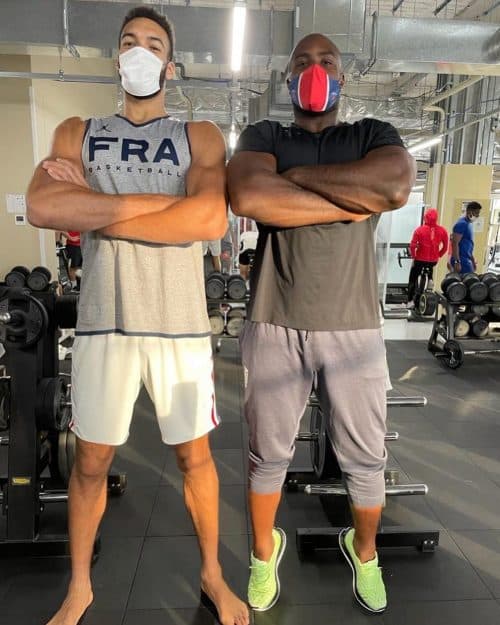
The average American figure in that table comes from the National Center for Health Statistics, which put the mean height of men aged 20 and over at 175.4 cm, or 69.1 inches, in its 1999 to 2016 series. Riner stands about 11 inches above it.
Five Olympic golds, seven Olympic medals
Riner has been to five Olympic Games and medaled at four of them.
| Games | Event | Result |
|---|---|---|
| Beijing 2008 | +100 kg | Bronze |
| London 2012 | +100 kg | Gold |
| Rio 2016 | +100 kg | Gold |
| Tokyo 2021 | +100 kg | Bronze |
| Tokyo 2021 | Mixed team | Gold |
| Paris 2024 | +100 kg | Gold |
| Paris 2024 | Mixed team | Gold |
Three of those golds are individual, which makes him only the second judoka to win three individual Olympic titles, after Japan’s Tadahiro Nomura. The Tokyo Games, held in 2021 after the year’s delay, are the strange entry: he lost in the individual quarterfinals, fought back for bronze, and then won the mixed team final two days later.
Eleven world titles, or twelve, depending who counts
This is the number that needs care, because sources genuinely disagree and the disagreement is not a typo.
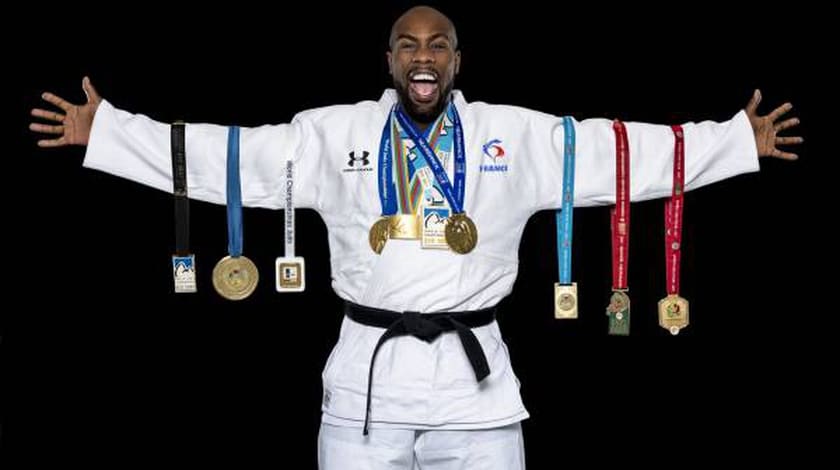
Riner has won nine world titles in the +100 kg category, in 2007, 2009, 2010, 2011, 2013, 2014, 2015, 2017 and 2023, plus two in the open category, which has no weight limit at all, in 2008 and 2017. That is eleven individual world titles, and it is the figure his own club used when it announced his return in 2026. He also won a world title with the French men’s team in 2011. Reference works that count team golds alongside individual ones therefore list twelve, and several news agencies have used that figure. Both numbers are defensible; the eleven is the one that describes him fighting alone.
Two further points of order. There were no world championships in the Olympic years 2012 and 2016, and between 2018 and 2022 he chose not to enter, which is why the gap in the list is longer than it looks. And one widely syndicated wire report dated his world titles as running “from 2009 through 2023,” which is wrong at the front end: the first came in Rio de Janeiro in 2007, when he was 18.
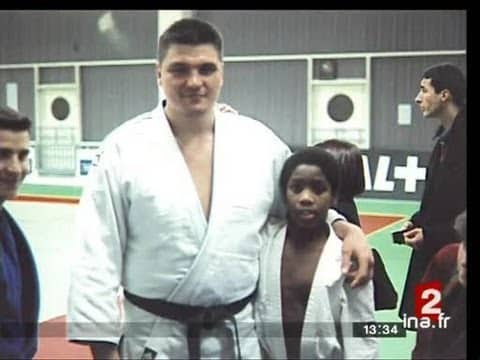
He also holds five individual European titles, in 2007, 2011, 2013, 2014 and 2016. In the French heavyweight line he follows David Douillet, who is 6 ft 5 in, won Olympic gold in Atlanta in 1996 and Sydney in 2000, and took four world titles. Riner has passed him on every count.
One hundred fifty-four contests without a loss
From September 2010 to February 2020, Riner fought 154 times and won 154 times. The streak ran for nine years and five months and is among the longest in any individual sport at the top level.
It ended in the third round of the Paris Grand Slam in February 2020, when Kokoro Kageura of Japan threw him. Kageura was ranked outside the world’s top 20 at the time. Riner stayed on the mat, shook hands, and said afterward that the loss had been coming for a while.
The context worth adding is that a judo streak is not a boxing streak. A heavyweight boxer might fight twice a year; Riner was fighting several times at most events, since a judo tournament is run as a one-day bracket. Those 154 wins were accumulated across roughly 30 competitions, not 154 separate paydays.
What his strength numbers show, and what they do not
One figure is documented: a 230 kg bench press, about 507 pounds, which he posted himself on social media in August 2017 with his training partners spotting. That is a genuinely heavy lift, though it is not close to a competitive powerlifting record and was never performed under competition conditions.
Other numbers travel with his name and should be treated with more caution. A 170 kg single-arm deadlift and 75 pull-ups in under five minutes both appear in profiles of him, and both trace back to interviews rather than to any measured session. We have not been able to verify either.
What is not in dispute is the shape of his training. Heavyweight judo is a grip sport before it is anything else, and his program is built on heavy compound lifts, a large volume of pulling work, and specific grip endurance. A heavyweight who cannot hold a lapse-free grip for four minutes loses to a man who can, regardless of what he benches.
Shoes, kit, and why American and British charts disagree
Riner wears a European 49.5. He is equipped by Under Armour, the Baltimore company, and has appeared in its campaigns.
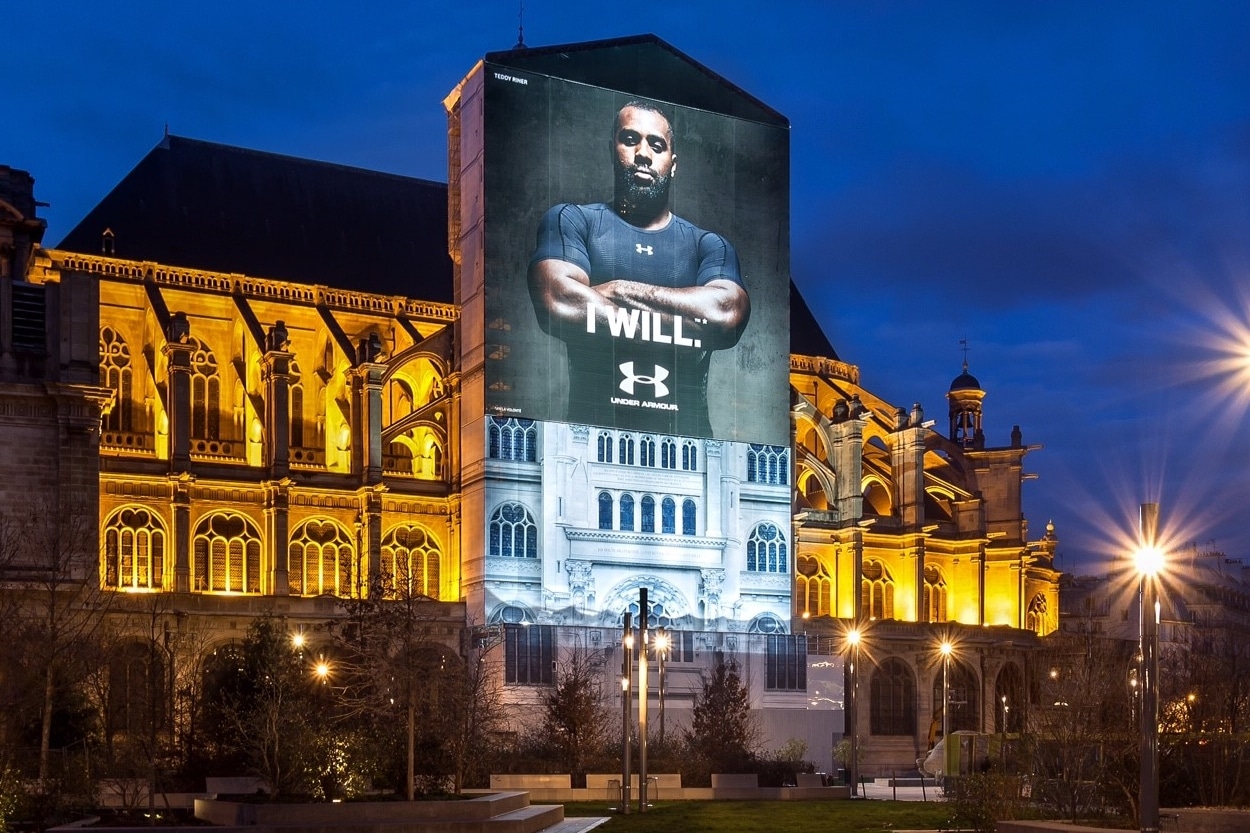
Converting that into an American number is less simple than it looks, and anyone who tells you there is one correct answer is selling something. There is no international standard for men’s shoe sizing. Different scales put the same European size at American numbers that differ by a full size, and the gap between the British and the American figure for one identical foot runs from half a size to a full size depending on whose chart you use. Nike, for instance, places a European 47.5 at US 13, while general-purpose conversion tables place the same 47.5 at US 13.5. At 49.5 the spread is wider still, landing somewhere around a US 15, and we would not put a single number on it. If you are buying at this end of the range, measure your foot in centimeters and work from that, not from a size label. Our table of large shoe sizes across the EU, CM, US and UK scales sets the competing figures side by side.
The judogi raises a related problem, since a competition jacket is cut to measured sleeve and body lengths rather than to a generic size, and the longest standard cuts stop well short of a 6 ft 8 in frame.
Why American judo has never produced a Riner
This is the honest comparison, and it is not flattering. USA Judo lists 14 Olympic medals in the sport’s whole history, counting from Jim Bregman’s bronze in 1964. Two of them are gold, both won by Kayla Harrison at 78 kg, in London in 2012 and Rio in 2016. In the men’s heaviest category, the United States has exactly one Olympic medal ever: Allen Coage’s bronze in the +93 kg division in Montreal in 1976.
The reason is not physical. The United States has no shortage of 6 ft 8 in, 300-pound athletes, but almost all of them are routed into football or basketball before they are 15, and the ones who want to fight go into wrestling, which has a far deeper high school and college infrastructure than judo will ever have here.
Where judo does show up in American sport is as a feeder. Ronda Rousey won Olympic judo bronze in 2008 and then became the first UFC women’s bantamweight champion. Kayla Harrison went from two Olympic judo golds to the UFC. Travis Stevens, silver medalist at 81 kg in 2016, is a serious Brazilian jiu-jitsu black belt. For most American fans, in other words, judo is the thing a cage fighter did first. Riner’s career is what the sport looks like when it is the destination rather than the on-ramp. If you want a different route into the same question, our piece on the best sports for tall people works through which disciplines actually convert height into results.
A shoulder, a missed world championship, and Los Angeles
Riner has not had a straightforward 2025 or 2026. He missed the 2025 world championships, and in 2026 he withdrew from the championships in Baku, held at the National Gymnastics Arena from October 4 to 11, because of a right shoulder problem. His trainer described a small loose fragment of bone causing sensitivity in the joint, called it not serious, and said it needed time. Riner had shoulder surgery once before, in 2013.
In September 2026 he re-signed with Paris Saint-Germain’s judo section on a contract running to 2028. He had been at the club from 2017 and last competed for it at the 2024 Champions League before the break. His stated target is the Los Angeles Games in 2028, which would be a sixth Olympics and, at 39, an attempt at a fourth individual gold. To get there he needs a top-10 world ranking, which he estimates will take five or six tournaments, so his comeback schedule is the thing to watch rather than any single result.
He has said he intends to retire after 2029. For a heavyweight who has already won more than anyone in the history of his weight class, the remaining question is narrow and hard: whether a 39-year-old shoulder can hold a lapel for four minutes against men who were in grade school when he started winning.
If you want other very large athletes measured properly, see our ranking of the tallest athletes of all time, our profile of Tyson Fury, the 6 ft 9 in heavyweight, and our look at Hafthor Bjornsson at 6 ft 9 in and 425 pounds. For another French giant working in an American league, there is Victor Wembanyama.
Sources
- Teddy Riner, biographical and competition record, consulted November 2026, for the medal tables, European titles and the streak.
- Associated Press, September 16, 2026, for the shoulder injury, the PSG contract to 2028, the Los Angeles target and the ranking requirement.
- NBC Sports, on his withdrawal from the 2026 world championships, for the description of the shoulder.
- 2026 World Judo Championships, for the Baku dates and venue.
- Paris Saint-Germain, announcement of Riner’s return, which gives eleven world titles in its text and nine in its list.
- USA Judo, Olympic Games medalists, for the American record including Allen Coage and Kayla Harrison.
- National Center for Health Statistics, anthropometric reference data, for the mean height of American men aged 20 and over.
- Heavyweight division under the unified rules, for the 265-pound ceiling.
- Rudy Gobert and Donovan Clingan, for the listed basketball heights and weights.
- David Douillet, for his height and his Olympic and world titles.