
Ella Katherine Ewing, born on 9 March 1872 in La Grange, Missouri, was billed for two decades as the tallest woman on earth. The figures attached to her name have never agreed with one another, and that disagreement is part of her story.
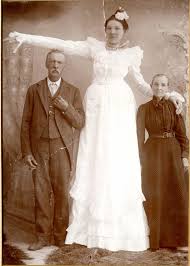
She was the only child of Benjamin and Anna Eliza Ewing, farmers of average height. Her growth began shortly after her seventh birthday and did not stop. At fourteen she measured 6 ft 10 in. Modern writers attribute the growth to pituitary gigantism, though no doctor diagnosed her in her lifetime, and no autopsy was performed.
Three heights, three sources
Guinness World Records lists her at 7 ft 4.5 in (224.8 cm) and notes she may have reached 2.46 m. Her mother’s journal recorded 8 ft 4 in (254 cm), a figure repeated by the historian Barbara Chasteen in a 1977 biography. Showmen billed her at 8 ft 2 in. Because no measurement was ever taken under controlled conditions and recorded by a physician, Guinness does not recognise her as the tallest woman in history, a title it gives to Zeng Jinlian. The honest position is the one the sources support: she was somewhere between 2.25 m and 2.54 m, and nobody can narrow it further.
The gap between the billed figure and the likely one is not unusual. It is the same gap that runs through almost every nineteenth-century giant, where the promoter set the number and nobody checked it.
From a church pew to the Chicago museums
The story of how she was discovered varies in the telling, but the turn came in 1892. The Chicago showman Lewis Epstein paid her 1,000 dollars for a twenty-seven-day engagement at his museum, then offered 5,000 dollars for five months. Her father reckoned the second offer against several years of farming income and accepted.
For the next two decades she appeared in dime museums, at fairs and with circuses across the United States. Ringling Bros. and Barnum & Bailey promoted her for a time as the tallest woman on earth. She was known everywhere as the Missouri Giantess.
What the money bought
She used her earnings to buy a 120-acre farm near Gorin, Missouri, and to build a house scaled to her: raised ceilings, taller doors, taller windows. It is a detail worth pausing on, because it is rare. Most of the people in the record of the tallest women lived in rooms built for everyone else. Ella Ewing is one of the few who earned enough to change the room.
Her chair, her bed and a pair of her shoes survive in local Missouri collections. The shoes are often cited at size 24, another figure that comes from showmen rather than from a cobbler’s record.
Death, and a vault lined with concrete
She died at her home near Gorin on 10 January 1913, aged 40, of tuberculosis and pneumonia. She had asked to be cremated, afraid that her body would be dug up and studied. Her father chose burial instead.
The undertaker Frederick Gerth commissioned a casket and a vault to her measurements and modified a horse-drawn hearse to carry them. The funeral was held on 13 January, through a severe winter storm, with ten pallbearers. She was buried at Harmony Grove Baptist Church Cemetery near Gorin, in a vault lined with concrete to deter grave robbers.
The precaution tells you what she feared, and what sideshow performers of her generation had reason to fear. Several of her contemporaries, including Édouard Beaupré, ended up as exhibits after death rather than in a grave.